Resource Library for Monopoly
The comprehensive encyclopedia for Monopoly: property values, probabilities, ROI analysis, railroads/utilities, housing economics, special spaces, and trading psychology. Built to earn authority and help you win.
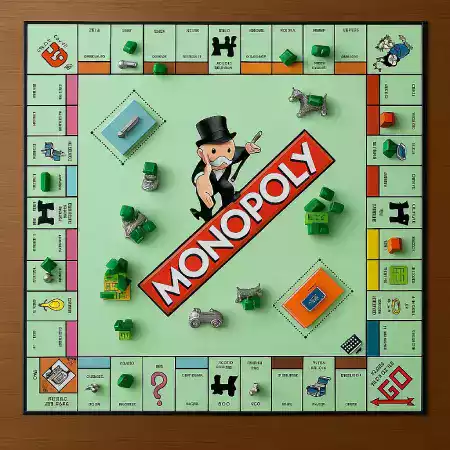
Property Values & Rent Table
Monopoly's economy is built on property investments. Each color group has different costs, returns, and strategic value.
| Property | Color Group | Purchase Cost | Rent (No Houses) | Rent (3 Houses) | Rent (Hotel) | House Cost | Strategy Rating | Traffic Level |
|---|---|---|---|---|---|---|---|---|
| Mediterranean Avenue | Brown | $60 | $2 | $180 | $250 | $50 | Early Game | Low |
| Baltic Avenue | Brown | $60 | $4 | $320 | $450 | $50 | Early Game | Low |
| Oriental Avenue | Light Blue | $100 | $6 | $500 | $700 | $50 | Early Game | Medium |
| Vermont Avenue | Light Blue | $100 | $6 | $500 | $700 | $50 | Early Game | Medium |
| Connecticut Avenue | Light Blue | $120 | $8 | $600 | $800 | $50 | Early Game | Medium |
| St. Charles Place | Pink | $140 | $10 | $700 | $900 | $100 | Early Game | Medium |
| States Avenue | Pink | $140 | $10 | $700 | $900 | $100 | Early Game | Medium |
| Virginia Avenue | Pink | $160 | $12 | $800 | $1000 | $100 | Early Game | Medium |
| St. James Place | Orange | $180 | $14 | $550 | $950 | $100 | Mid Game | Very High |
| Tennessee Avenue | Orange | $180 | $14 | $550 | $950 | $100 | Mid Game | Very High |
| New York Avenue | Orange | $200 | $16 | $600 | $1000 | $100 | Mid Game | Very High |
| Kentucky Avenue | Red | $220 | $18 | $700 | $1050 | $150 | Mid Game | High |
| Indiana Avenue | Red | $220 | $18 | $700 | $1050 | $150 | Mid Game | High |
| Illinois Avenue | Red | $240 | $20 | $800 | $1100 | $150 | Mid Game | High |
| Atlantic Avenue | Yellow | $260 | $22 | $850 | $1150 | $150 | Mid Game | Medium |
| Ventnor Avenue | Yellow | $260 | $22 | $850 | $1150 | $150 | Mid Game | Medium |
| Marvin Gardens | Yellow | $280 | $24 | $900 | $1200 | $150 | Mid Game | Medium |
| Pacific Avenue | Green | $300 | $26 | $1100 | $1275 | $200 | Late Game | Low |
| North Carolina Avenue | Green | $300 | $26 | $1100 | $1275 | $200 | Late Game | Low |
| Pennsylvania Avenue | Green | $320 | $28 | $1200 | $1400 | $200 | Late Game | Low |
| Park Place | Dark Blue | $350 | $35 | $1750 | $2000 | $200 | Late Game | Very Low |
| Boardwalk | Dark Blue | $400 | $50 | $2000 | $2000 | $200 | Late Game | Very Low |
Strategic Analysis Summary
🏆 Best Early Game Investment
Orange Set - Highest ROI with moderate cost. Perfect for mid-game dominance.
💰 Best Value for Money
Brown Properties - Cheap to buy and develop, surprisingly effective with 3 houses.
⚠️ Risky Investments
Dark Blue Properties - Expensive and rarely landed on. Only buy if you have cash flow.
🎯 Mid-Game Powerhouses
Red Set - High traffic area with good returns. Pairs well with Orange strategy.
🟩 Underrated Green Set
Green Properties - Expensive to develop but can deliver huge payouts late game. Best if you can afford to build houses quickly.
🟪 Purple's Sneaky Potential
Magenta (Pink) Set - Often overlooked, but with three houses, these can drain opponents' cash thanks to their location after Jail.
Railroads & Utilities
Railroads and Utilities represent two distinct investment strategies in Monopoly. While railroads offer consistent cash flow, utilities provide variable returns based on dice rolls. Understanding their mechanics is crucial for strategic gameplay.
🚂 Railroads: The Steady Income Generators
Reading Railroad
Cost: $200
Base Rent: $25
Pennsylvania Railroad
Cost: $200
Base Rent: $25
B&O Railroad
Cost: $200
Base Rent: $25
Short Line
Cost: $200
Base Rent: $25
Railroad Rent Structure
🚂 Railroad Strategy
- Early Game: Buy railroads when you land on them - they're excellent for cash flow
- Mid Game: Trade aggressively to collect 3-4 railroads for maximum rent
- Late Game: Railroads become less valuable as property rents skyrocket
- Mortgage Value: $100 each - useful for emergency cash
⚡ Utilities: Variable Return Investments
Electric Company
Cost: $150
Rent: 4× dice roll
Water Works
Cost: $150
Rent: 4× dice roll
Rent Calculation Examples
Single Utility
Roll 7: Rent = 4 × 7 = $28
Roll 12: Rent = 4 × 12 = $48
Both Utilities
Roll 7: Rent = 10 × 7 = $70
Roll 12: Rent = 10 × 12 = $120
⚡ Utility Strategy
- Low ROI: Utilities have the worst return on investment in the game
- Dice Dependent: Returns vary wildly based on dice rolls
- Monopoly Value: Only valuable if you own both utilities
- Mortgage Value: $75 each - low emergency cash value
📊 Railroads vs Utilities: Investment Analysis
💡 Pro Tips for Railroads & Utilities
🚂 Railroad Mastery
- Never trade away railroads unless you're getting a monopoly in return
- 3 railroads generate $100 rent - excellent mid-game income
- Use railroads as bargaining chips in complex trades
⚡ Utility Wisdom
- Only buy utilities if they're very cheap ($50-75)
- Utilities are better for blocking opponents than generating income
- Consider selling utilities to fund property development
Probability of Landing on Spaces
Monopoly isn't just luck — it's math. Dice rolls follow probability curves.
🎲 Dice Probability Fundamentals
Most Common Rolls
Roll 7: 16.67% chance
Roll 6 & 8: 13.89% each
Roll 5 & 9: 11.11% each
Least Common Rolls
Roll 2 & 12: 2.78% each
Roll 3 & 11: 5.56% each
Roll 4 & 10: 8.33% each
🚶 Board Traffic Analysis
🔥 High Traffic Zone
Most Landed On Spaces:
- Jail - 3 ways to land here
- Illinois Avenue - Post-Jail hotspot
- B&O Railroad - High probability area
- Orange Set - Post-Jail traffic
- Red Set - Mid-game frequency
👉 Strategy: These properties generate consistent income. Orange and Red sets are gold mines!
🟡 Medium Traffic Zone
Moderate Frequency:
- Light Blue Set - Early game focus
- Pink Set - Balanced traffic
- Yellow Set - Mid-game activity
- Green Set - Late game potential
- Railroads - Consistent visits
👉 Strategy: Good for building monopolies, but prioritize high-traffic areas first.
❄️ Low Traffic Zone
Rarely Visited:
- Mediterranean Avenue - Board corner
- Park Place - Expensive isolation
- Utilities - Low probability
- Dark Blue Set - Luxury trap
- Baltic Avenue - Corner property
👉 Strategy: Avoid these unless very cheap. They're money pits with low ROI.
🚔 Jail's Impact on Board Traffic
Why Jail Creates Traffic Patterns
- Jail Release: Players often roll 6-8 after leaving Jail
- Orange Set: 6-8 spaces from Jail = high traffic
- Red Set: 8-10 spaces from Jail = consistent visits
- Illinois Avenue: Perfect post-Jail landing spot
🚔 Jail Traffic Strategy
Early Game: Buy properties 6-10 spaces from Jail
Mid Game: Focus on Orange and Red monopolies
Late Game: Use Jail as a safe haven from high rents
🎯 Probability-Based Strategy
📊 Buy by Numbers, Not Names
- Orange Set (6-8 from Jail) > Dark Blue (corner isolation)
- Red Set (8-10 from Jail) > Utilities (low probability)
- Railroads (even distribution) > Corner properties
🎲 Calculate Expected Value
- High traffic × High rent = Maximum ROI
- Low traffic × High rent = Poor investment
- Medium traffic × Low cost = Good early game
💡 Pro Tips for Probability Mastery
🎯 Traffic-First Strategy
- Always prioritize high-traffic properties over prestigious ones
- Orange and Red sets are statistically the best investments
- Use probability to justify trades to opponents
🚔 Jail-Aware Positioning
- Properties 6-10 spaces from Jail are gold mines
- Post-Jail traffic is more predictable than random rolls
- Build houses on high-traffic properties first
📈 ROI vs. Probability
- High probability × High rent = Maximum ROI
- Focus on frequency, not just rent amounts
- Probability creates consistent income streams
Return on Investment (ROI) by Color Group
Understanding ROI by color group is the key to strategic Monopoly success. Not all properties are created equal — some offer exceptional returns while others are financial traps. This analysis breaks down each color group's investment potential, development costs, and long-term profitability.
🏆 ROI Champions: The Elite Investment Groups
🟧 Orange Set - The ROI King
Why Orange is the Best Investment:
- Traffic: Highest landing probability in the game
- Development: Fastest house building potential
- Pressure: Creates immediate rent pressure
- Recovery: Pays for itself in 2-3 landings
🟥 Red Set - The Mid-Game Powerhouse
Red Set Advantages:
- Traffic: High post-Jail landing frequency
- Value: Perfect mid-game investment timing
- Pressure: Strong rent pressure with houses
- Flexibility: Good mortgage value for emergencies
🥈 ROI Contenders: Solid Investment Choices
🟦 Light Blue Set - Early Game Foundation
Light Blue Benefits:
- Early Game: Perfect first investment
- Cash Flow: Consistent early income
- Development: Very cheap to build houses
- Recovery: Quick return on investment
🟨 Yellow Set - Balanced Investment
Yellow Set Strengths:
- Balance: Good cost-to-rent ratio
- Traffic: Moderate landing frequency
- Development: Reasonable house costs
- Pressure: Strong rent pressure potential
⚠️ ROI Risky: High-Risk, High-Reward Properties
🟦 Dark Blue Set - The Luxury Trap
Dark Blue Challenges:
- Traffic: Very low landing probability
- Cost: Extremely expensive to develop
- Recovery: Takes forever to pay for itself
- Risk: Can bankrupt you if developed early
🟩 Green Set - Late Game Risk
Green Set Issues:
- Timing: Only valuable in late game
- Traffic: Low landing frequency
- Development: Expensive house costs
- Pressure: Weak early-mid game pressure
🎯 ROI Surprises: Hidden Gems
🟫 Brown Set - The Budget King
Why Brown is Surprisingly Good:
- Cost: Dirt cheap to buy and develop
- Recovery: Pays for itself very quickly
- Pressure: Creates early rent pressure
- Value: Excellent early game investment
🩷 Pink Set - The Balanced Choice
Pink Set Advantages:
- Balance: Good cost-to-rent ratio
- Timing: Perfect early-mid game investment
- Development: Reasonable house costs
- Pressure: Creates solid rent pressure
📊 ROI Comparison Matrix
🎯 ROI-Based Investment Strategy
💰 Early Game (Turns 1-10)
- Priority 1: Brown Set - cheapest monopoly
- Priority 2: Light Blue Set - early cash flow
- Priority 3: Orange Set - if you can afford it
- Avoid: Dark Blue, Green - too expensive early
🏗️ Mid Game (Turns 11-25)
- Priority 1: Orange Set - best ROI in the game
- Priority 2: Red Set - excellent mid-game value
- Priority 3: Yellow Set - balanced investment
- Focus: Building houses on existing monopolies
🏆 Late Game (Turns 26+)
- Luxury: Dark Blue Set - if you're winning
- Pressure: Green Set - for final domination
- Strategy: Focus on house building, not buying
- Goal: Create maximum rent pressure
💡 Pro Tips for Maximum ROI
📈 ROI Calculation Formula
- ROI = (Annual Rent - Total Investment) / Total Investment × 100%
- Consider landing frequency in your calculations
- Factor in house building costs and timing
- Account for mortgage value and flexibility
🎯 Investment Timing
- Buy Orange and Red sets as early as possible
- Develop houses on high-ROI properties first
- Use low-ROI properties as bargaining chips
- Never overpay for prestige properties
🚫 Common ROI Mistakes
- Buying Dark Blue properties early game
- Ignoring traffic patterns in ROI calculations
- Developing low-traffic properties first
- Not considering house building costs
House & Hotel Economics
Understanding housing economics is the key to dominating Monopoly. Houses and hotels aren't just about collecting higher rent—they're strategic weapons that control the housing supply and create pressure on opponents.
🏠 House Building Strategy
- Sweet Spot Rule: Build 3 houses per property for maximum ROI
- Supply Control: Houses are limited—building early denies opponents
- Pressure Building: 3 houses create consistent financial pressure
- Risk Management: Avoid over-investing in one property
🏨 Hotel Economics
- Double-Edged Sword: Hotels maximize rent but free up houses
- Supply Liberation: Hotels return 4 houses to the bank
- Timing Critical: Build hotels only when you can afford to lose houses
- Late Game Power: Hotels can finish off weakened opponents
💰 Financial Impact
- Rent Multipliers: Houses increase rent exponentially
- Bankruptcy Potential: 3 houses can bankrupt in one roll
- Cash Flow: Houses provide steady income stream
- Investment Recovery: Houses pay for themselves in 3-4 landings
Advanced Housing Tactics
Supply Denial Strategy
Build houses on properties you don't own to deny opponents. Even if you can't collect rent, you're preventing them from building and creating pressure.
Housing Pressure Timing
Coordinate house building across multiple monopolies to create simultaneous pressure. This forces opponents to make difficult financial decisions.
Hotel Conversion Strategy
Convert to hotels strategically—only when you have multiple monopolies or when opponents are too weak to benefit from freed houses.
Housing ROI Calculator
Pro Tips for Housing Success
Early Game
Focus on completing monopolies before building houses. A monopoly with no houses is better than a single property with houses.
Mid Game
Build houses evenly across your monopolies to create consistent pressure. Don't max out one property while others sit empty.
Late Game
Convert to hotels only when you can afford to lose the houses. Hotels are finishers, not builders.
🎯 Key Strategy: Houses are your primary weapon in Monopoly. Build them early, spread them evenly, and use them to create relentless financial pressure on your opponents. Remember: it's not just about the rent you collect—it's about the houses your opponents can't build.
Trading & Deal-Making Resources
Mastering the art of trading and deal-making is what separates good Monopoly players from great ones. Understanding value, timing, and psychology can turn a losing position into a winning one through strategic negotiations.
🔄 Trade Fundamentals
- Two-for-One Rule: Two lesser properties for one monopoly piece is usually profitable
- Monopoly Priority: Always prioritize completing monopolies over individual properties
- Value Assessment: Consider both current rent and future housing potential
- Timing Matters: Early trades are more valuable than late-game desperation deals
💰 Cash + Property Deals
- Sweetening Offers: Use cash to bridge value gaps in property trades
- Don't Overpay: Cash is king—don't sacrifice too much for properties
- Housing Investment: Cash spent on trades should lead to housing opportunities
- Emergency Reserves: Always keep cash for rent payments and house building
🚫 What NOT to Trade
- Railroads Late-Game: ROI drops significantly once housing pressure starts
- Utilities: Low rent potential makes them poor trade targets
- Single Properties: Avoid trading for properties that don't complete sets
- Overvalued Properties: Don't pay premium for properties you can't develop
Advanced Trading Strategies
Psychological Warfare
Use timing and pressure to your advantage. Players are more likely to make bad deals when they're desperate or when you create urgency. Watch for signs of financial stress in opponents.
Multi-Party Negotiations
Involve multiple players in complex trades. Sometimes a three-way deal can benefit everyone and help you complete monopolies that two-way trades couldn't achieve.
Future Value Trading
Trade based on what properties will be worth after housing, not just current rent values. A property with 3 houses is worth exponentially more than its base value.
Trade Value Calculator
Pro Trading Tips
Early Game (Turns 1-10)
Focus on completing monopolies. Be aggressive with trades and don't be afraid to overpay slightly for the last piece of a set. The earlier you get monopolies, the more time you have to build houses.
Mid Game (Turns 11-25)
Balance trading with house building. Look for opportunities to complete additional monopolies while maintaining cash for housing. This is when most games are won or lost.
Late Game (Turns 26+)
Focus on finishing off opponents. Avoid trading unless it directly leads to victory. Cash and houses are more valuable than property trades at this stage.
Negotiation Psychology
Reading Opponents
Watch how opponents talk about their properties. Players who mention specific properties frequently often overvalue them. Use this information to your advantage in negotiations.
Creating Urgency
Use phrases like "This is my final offer" or "I need to decide now" to create pressure. Most players will make concessions when they feel time is running out.
Silence is Golden
After making an offer, stay quiet. The first person to speak usually loses. Let opponents fill the silence with concessions or counter-offers.
🎯 Key Strategy: Successful trading in Monopoly is about understanding value, timing, and psychology. Always trade with a purpose—either to complete monopolies or to gain strategic advantages. Remember: the best trade is one that advances your position while weakening your opponents'.
Special Spaces & Game Mechanics
Special spaces in Monopoly aren't just random events—they're strategic opportunities that can dramatically change the course of the game. Understanding how to use them to your advantage is crucial for victory.
🚔 Jail Strategy
- Late-Game Safety: Jail becomes a sanctuary when you're low on cash
- Rent Collection: You still collect rent while in jail
- Free Parking: Jail protects you from landing on expensive properties
- Strategic Timing: Use jail to avoid bankruptcy during housing pressure
🎲 Chance & Community Chest
- Risk Assessment: Consider nearby property sets before drawing
- Cash Flow: These cards can provide emergency funds
- Property Movement: Some cards move you to valuable locations
- Tax Relief: Community Chest often provides financial assistance
🏁 GO & Income Tax
- GO Bonus: $200 can fund house building or trades
- Tax Planning: Keep cash for 10% income tax payments
- Pace Control: Passing GO resets the game rhythm
- Emergency Fund: GO money can save you from bankruptcy
Advanced Special Space Tactics
Jail Timing Strategy
Time your jail stays strategically. Go to jail when you have properties that need protection, or when you want to avoid expensive landings. Use the "Get Out of Jail Free" card only when it provides maximum strategic value.
Card Probability Management
Track which Chance and Community Chest cards have been played. This helps you calculate the odds of drawing beneficial or harmful cards, allowing you to make informed decisions about property purchases and house building.
Tax Optimization
Plan your cash flow around tax payments. Sometimes it's better to pay the 10% income tax than to liquidate properties. Keep emergency funds specifically for these unexpected expenses.
Special Space Impact Calculator
Pro Tips for Special Spaces
Early Game (Turns 1-10)
Use Chance and Community Chest cards aggressively. The $200 GO bonus is crucial for early property acquisition. Don't worry about jail—you want to be moving around the board to buy properties.
Mid Game (Turns 11-25)
Balance risk and reward with special spaces. Use jail strategically to avoid expensive landings while you build houses. Keep emergency funds for tax payments and unexpected expenses.
Late Game (Turns 26+)
Jail becomes your best friend. Use it to avoid bankruptcy while your houses generate income. Special space cards are less valuable now—focus on protecting your position.
Psychological Impact of Special Spaces
Jail Psychology
Players often feel trapped in jail, but it can be a strategic advantage. Use jail time to plan your next moves and let opponents make mistakes while you're protected.
Card Anticipation
Players develop superstitions about certain cards. Use this to your advantage by creating uncertainty about your strategy when you land on special spaces.
GO Celebration
Passing GO feels like a victory, but don't let it distract you from strategic decisions. The $200 is valuable, but how you spend it matters more than getting it.
🎯 Key Strategy: Special spaces are not random events—they're strategic tools. Use jail for protection, cards for opportunities, and GO for cash flow. The key is timing: use each special space when it provides maximum strategic value for your current game position.
Player Behavior Insights & Psychology
Understanding human psychology and player behavior is the secret weapon that separates elite Monopoly players from the rest. Learn to read your opponents, exploit their biases, and use psychological warfare to your advantage.
🎭 Property Value Biases
- Boardwalk Overvaluation: Players consistently overvalue Boardwalk due to its prestige
- Orange/Red Undervaluation: These sets are often undervalued despite high ROI
- Color Psychology: Players prefer certain colors based on personal associations
- End-Game Bias: Properties near GO are overvalued due to perceived safety
🧠 Negotiation Psychology
- Emotional Decision Making: Use timing and pressure to create emotional responses
- Loss Aversion: Players fear losing more than they value gaining
- Anchoring Effect: First offers set the psychological baseline for negotiations
- Social Proof: Players follow the crowd—use this to your advantage
🎯 Reading Opponents
- Property Talk Frequency: Players mention properties they overvalue
- Cash Flow Anxiety: Watch for signs of financial stress
- Risk Tolerance: Some players are naturally more aggressive
- Pattern Recognition: Players repeat successful strategies
Advanced Psychological Tactics
Information Warfare
Control what information you reveal and when. Let opponents think they have the upper hand, then strike when they're overconfident. Use selective transparency to create uncertainty and force mistakes.
Emotional Manipulation
Create emotional states in your opponents that lead to poor decisions. Use frustration, fear, and greed to your advantage. Remember: emotional players make rational mistakes.
Group Dynamics
In multi-player games, understand alliance formation and group psychology. Position yourself as the mediator while secretly advancing your own interests. Use group pressure to force opponents into bad deals.
Player Psychology Risk Assessment
Pro Psychology Tips
Early Game (Turns 1-10)
Observe and categorize your opponents. Identify who is emotional, who is analytical, and who is conservative. Build your psychological profile of each player for later exploitation.
Mid Game (Turns 11-25)
Start applying psychological pressure. Use the information you gathered to create situations where each opponent's weaknesses are exposed. This is when most psychological battles are won.
Late Game (Turns 26+)
Execute your psychological endgame. Use fear, desperation, and overconfidence to force opponents into fatal mistakes. Remember: the mind game is often more important than the board game.
Advanced Mind Games
Reverse Psychology
Sometimes the best way to get what you want is to pretend you don't want it. Use reverse psychology to make opponents think they're getting the better deal when they're actually helping you.
Information Asymmetry
Create situations where you know more than your opponents. Use this knowledge gap to make them think they're making informed decisions when they're actually walking into traps.
Emotional Contagion
Your emotional state affects others. Stay calm and confident to make opponents doubt themselves. Use your emotional stability as a weapon against their instability.
🎯 Key Strategy: Player behavior insights are your psychological advantage in Monopoly. Learn to read opponents, exploit their biases, and use psychological warfare strategically. Remember: the best players don't just play the board—they play the people.